Carpoolio
Status: The Carpoolio brand was acquired to avoid marketplace confusion with another product. As part of that acquisition, the app was delisted and the project is no longer active. This page documents the work and lessons learned building it.
Carpoolio was the first full-stack web application I built and designed to solve a real-world problem
while helping me solidify my skills in frontend and backend development.
The project started as an experiment in building a practical, user-friendly tool that streamlined carpool planning for groups of friends traveling together.
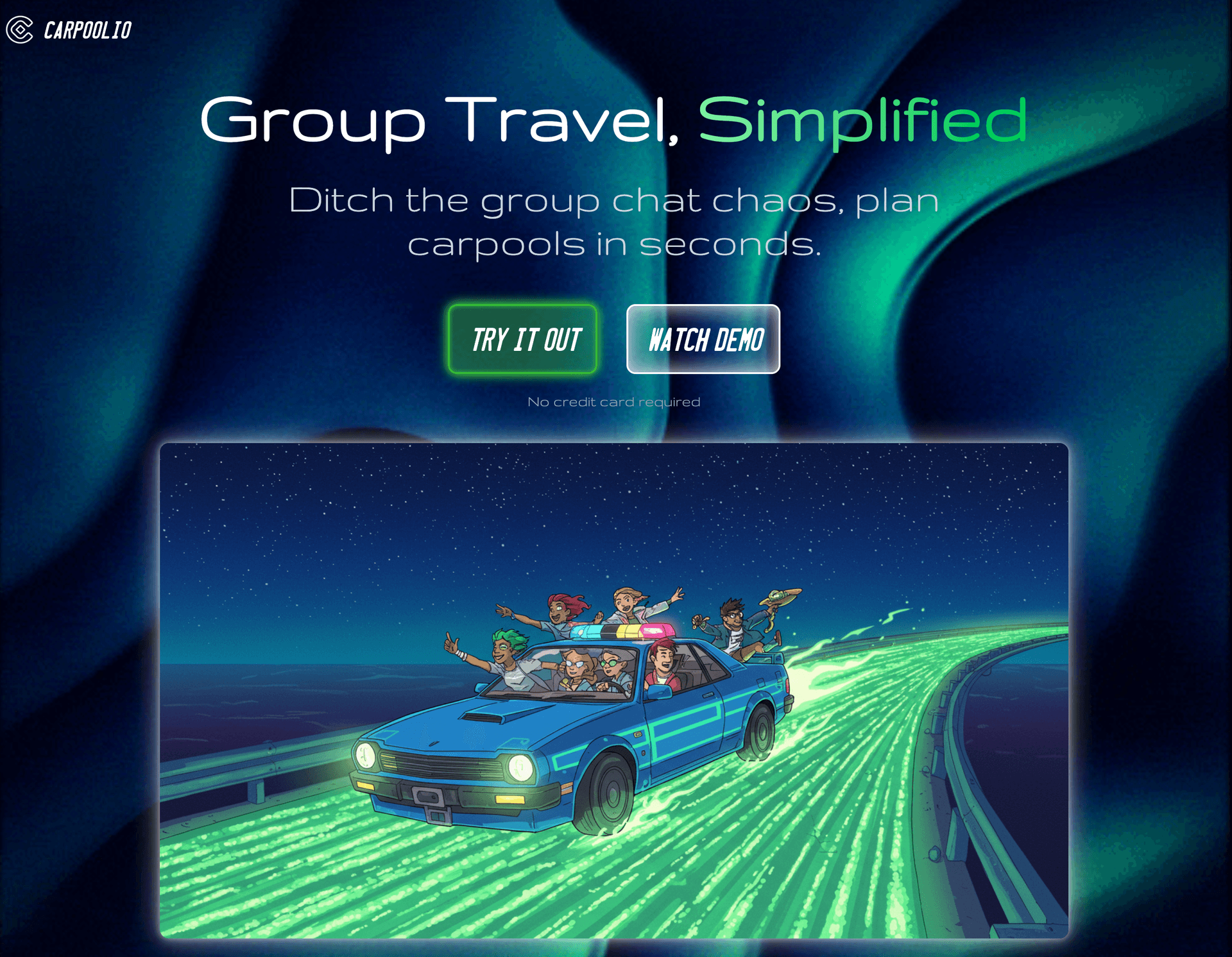
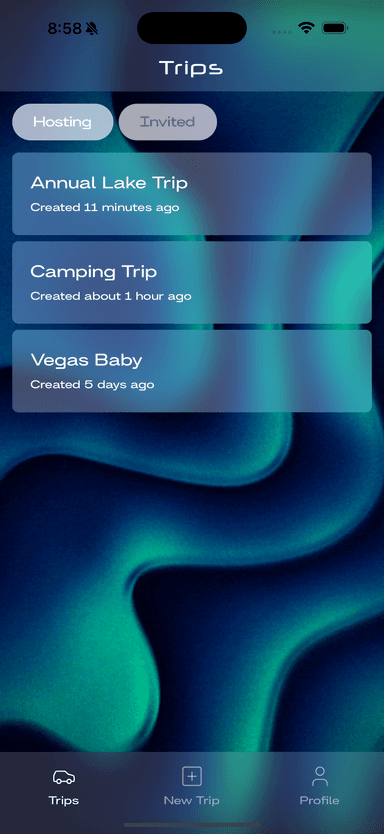
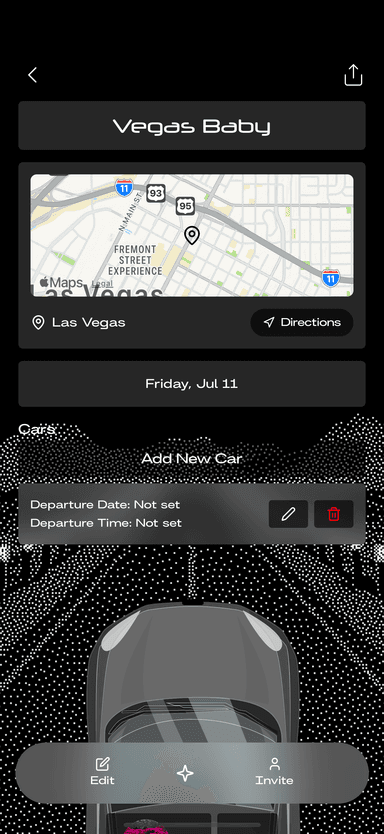
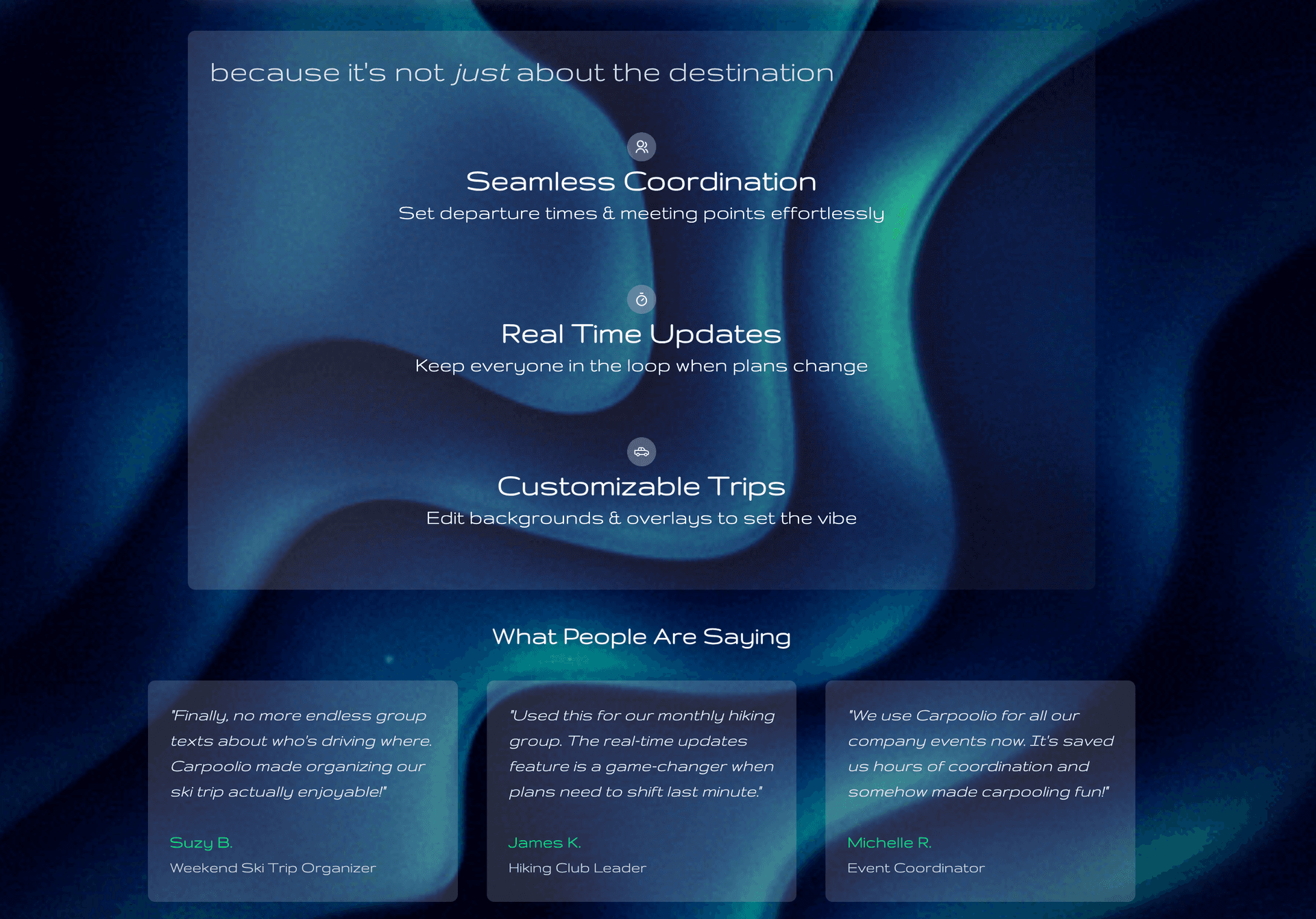
Built with people's real problems in mind, it allowed users to create trips, add vehicles, and assign seats through a playful interface.
Prior to being delisted, Carpoolio was available as both a web application and an iOS mobile app, making it easy for groups to coordinate rides, plan trips, and assign seats on the go.
Project Purpose & Goal
Planning a trip with multiple cars and passengers can quickly become overwhelming, especially when coordination happens through fragmented group chats, spreadsheets, or last-minute messages. Instead of relying on fragmented messaging, Carpoolio solved this problem by centralizing ride coordination, making group trips smoother and more efficient.
Unlike traditional carpooling apps focused on daily commutes or ride-sharing with strangers, Carpoolio ws tailored for pre-existing groups—people who already know each other but need a better way to organize their rides. Whether it's a road trip, a festival, or an out-of-town event, the app provided a dedicated space to plan rides, assign seats, and ensure that everyone knows who they're traveling with, when they're leaving, and how they're getting there.


Stack & Explanation
For Carpoolio, I chose a straightforward tech stack that was easy to set up while still allowing me to grow as a developer.
For the frontend, I opted for React, paired with Vanilla CSS for custom styling initially, however I ended up installing Tailwind because I found it to be far less complicated than managing classes and css files.
For the backend, I used Node.js and Express to build a robust server-side application that handled data storage and retrieval. Vercel Postgres handled the database, providing a scalable and reliable solution for storing and querying trip and user data.
Overall, I aimed for a tech stack that was both practical and accessible, giving me room to grow as I gained more experience.
When converting it to a mobile app, I switched to React Native and Nativewind for styling.
Problems & Thought Process
Since it was my first web application, naturally I ran into lots of problems. Early on, I had trouble creating reusable components. It was easy to create a one-off component, but making it flexible and reusable across the app required thinking about props, state management, and keeping things modular.
I didn't realize how important it was to test the application across different browsers (and later devices). Certain styles and features worked fine on one browser but caused issues on others, requiring me to tweak the CSS and use fallback techniques. I started with Vanilla CSS for custom styling, however I ended up installing Tailwind CSS after learning it from another project because I found it less complicated than managing separate classes and CSS files. While this made styling easier, I still considered rewriting some parts for better organization. I struggled with organizing components, pages, and styles, especially when using pure CSS. Even though I learned about CSS variables, which helped simplify the process, it was still tough to bounce back and forth between components and their respective styles.
These challenges were part of the learning process, but with each one, I gained a deeper understanding of the web development workflow and how to build more efficient and scalable applications.
Lessons Learned
Knowing what I know now, I would probably have made a more simple web app as carpoolio's functionality was quite complex for a novice developer. As the app grew, I found managing state ( especially user-related data) across multiple components a bit difficult. It forced me to learn the importance of lifting state up and prop drilling.
One of the key lessons I learned while working on Carpoolio, especially on the backend, was the importance of using environment variables. I needed to add the IP address of the Wi-Fi network I was connected to for the backend to function properly. However, every time I worked on Carpoolio from a different location (coffee shops, friend's houses, etc.), I would have to manually update the IP address in my configuration files. This process became tedious and error-prone, so I started using environment variables to store values like IP addresses and API keys. This made the application more portable and less dependent on specific environments, helping me work across different networks seamlessly.
These lessons have really helped me grow as a developer and changed the way I approach problems in this project. Handling state, environment variables, and debugging has definitely made me more efficient. It's been a journey of figuring out what works best for managing complexity and making things run smoothly. Every challenge has helped me improve the way I approach building out features and handling issues in Carpoolio.